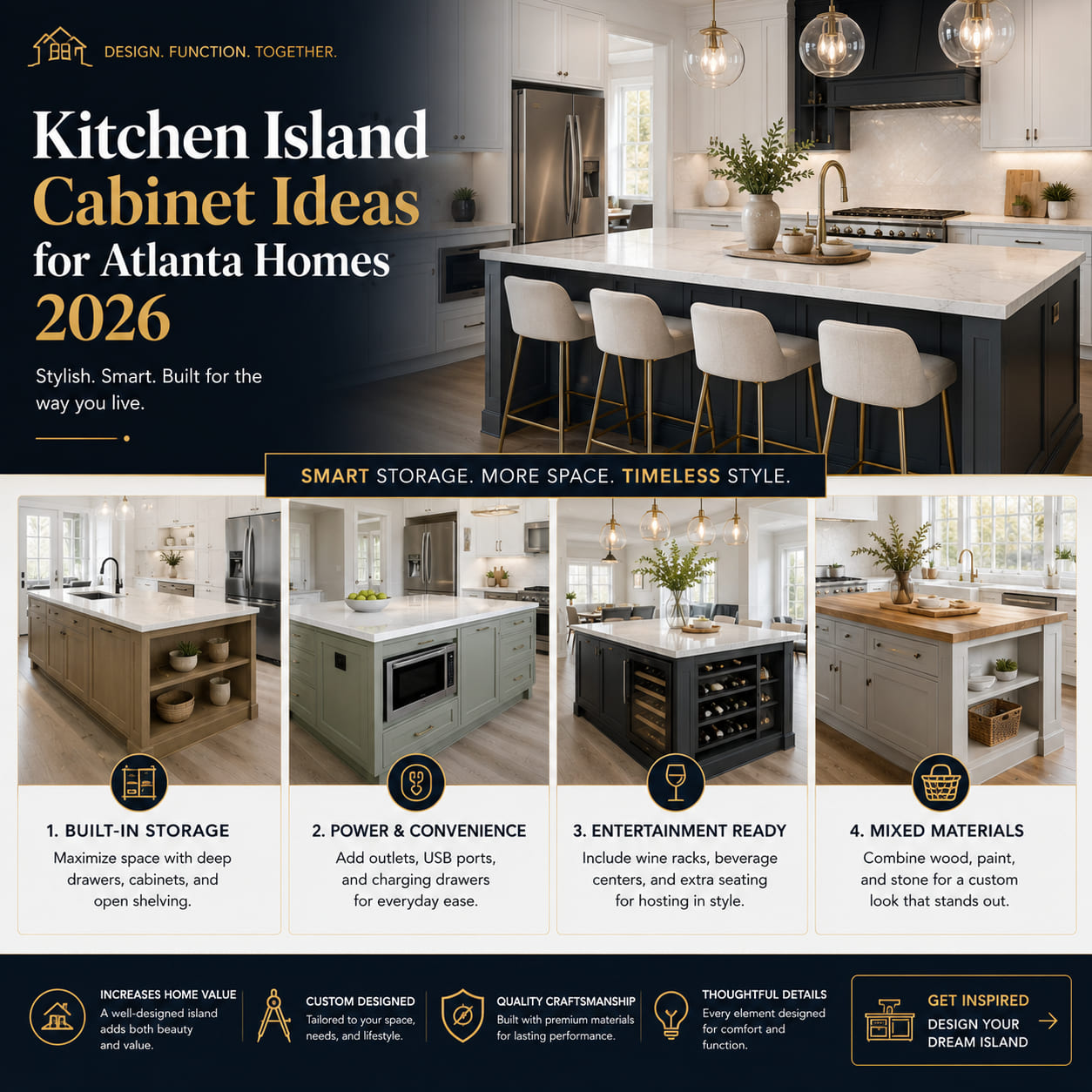
Walk into almost any kitchen remodel happening in Atlanta right now and you'll find a kitchen island somewhere in the conversation. Homeowners want them. Buyers expect them. And when done right, a well-designed island with built-in cabinets adds more functional value per square foot than almost any other single upgrade in the kitchen.
But "kitchen island with cabinets" covers a lot of ground. There's a big difference between a basic base cabinet island dropped in the center of a room and a custom-built island designed around how your family actually uses the kitchen. This guide walks through the cabinet configurations, styles, and design decisions that are working best in Atlanta homes this year.
A kitchen island earns its keep in two ways: daily function and long-term home value.
On the functional side, a cabinet-based island gives you counter space, hidden storage, and often a place to sit — all in one footprint. Instead of hunting through lower cabinets across the kitchen for pots, baking sheets, or small appliances, you have dedicated storage right where you prep and cook.
On the value side, Atlanta's real estate market consistently rewards kitchens with islands. Homes in Dunwoody, East Cobb, and Peachtree City that list with updated kitchen islands move faster and appraise higher than comparable homes without them. If you're planning to sell within five years, a well-executed island almost always returns more than it costs.
The most common island configuration is a run of base cabinets on one or both sides of the island, topped with a countertop overhang on the seating side. You get deep storage drawers, door cabinets, or a mix of both below, and bar-stool seating above the overhang.
This works well in kitchens where storage is the primary goal. Drawers on the prep side keep utensils, cutting boards, and wraps within arm's reach. Door cabinets on the seating side can hold kids' snacks, extra dishes, or small appliances you don't want cluttering the counters.
Best for: families who cook daily and need organized, accessible storage without a lot of complexity.
One of the more popular looks right now in Atlanta kitchens pairs closed base cabinets on one end of the island with two or three open shelves on the other. The open shelves break up the visual weight of an all-cabinet island and give you a place to display cookbooks, a fruit bowl, or a few plants without making the kitchen feel closed off.
The key is keeping open shelves intentional. They look great in a showroom and in photos — but they need to stay edited. One shelf of cluttered random items kills the look fast.
Best for: transitional and modern kitchens where the island is also a design statement, not just a storage unit.
The two-tone trend — where island cabinets are a different color than the perimeter cabinets — isn't slowing down in 2026. In Atlanta homes, the most requested combinations right now are:
The contrast creates a natural focal point and makes smaller kitchens feel more intentional and layered. It also lets homeowners add a bolder color without committing the entire kitchen to it.
Best for: homeowners who want personality in the kitchen without a full redesign.
A waterfall island extends the countertop material down the sides of the island all the way to the floor, creating a seamless vertical panel. Underneath, the cabinets are typically set back slightly, leaving the waterfall edge as the dominant visual feature.
This is a higher-cost option — you're using more countertop material and the installation is more complex — but the result is one of the cleanest, most high-end looks in kitchen design. Quartz and quartzite both work beautifully in waterfall applications.
In Atlanta, this configuration appears most often in newer construction in Alpharetta and Milton, and in gut-renovation projects in older Buckhead and Brookhaven homes.
Best for: contemporary and minimalist kitchens where the island is meant to be a showpiece.
Standard cabinet doors are fine, but pull-out drawers and specialty inserts unlock a completely different level of organization. Common additions that Atlanta homeowners are requesting in 2026:
None of these cost a fortune individually, but together they turn a standard island into something that genuinely changes how the kitchen functions day to day.
Best for: homeowners who prioritize organization and are doing a full remodel with new cabinetry.
In larger Atlanta kitchens — particularly open floor plans in newer Suwanee and Johns Creek homes — some homeowners are building islands that function almost like a second prep station or butler's pantry. These tend to be longer (8–10 feet), with a sink or prep sink on one end, lower cabinets and drawers throughout, and sometimes upper cabinets or a microwave drawer built into one end.
This configuration works best when the kitchen layout has enough room to walk comfortably around all sides of the island without feeling cramped. A general rule: leave at least 42 inches of clearance on working sides, 36 inches on non-working sides.
Best for: large kitchens where the island is effectively a second work zone, not just extra counter space.
The island doesn't have to match the perimeter cabinets exactly — but it should feel like it belongs in the same room. A few combinations that work well together:
Shaker island + shaker perimeter: Classic, always appropriate, easy to resell. Works in traditional, transitional, and farmhouse kitchens.
Flat-front island + shaker perimeter: A popular transitional move — the sleek island modernizes the kitchen without requiring a full cabinet replacement.
Flat-front island + flat-front perimeter: The cleanest, most contemporary look. Works best when countertops and hardware have some warmth or texture to prevent the kitchen from feeling cold.
Avoid mixing highly ornate door styles on the island with very simple perimeter cabinets — or vice versa. The contrast reads as a mistake rather than an intentional design choice.
Costs vary significantly depending on size, cabinet quality, countertop material, and whether plumbing or electrical work is involved. Realistic ranges for Atlanta in 2026:
If your island requires a new sink, that adds plumbing rough-in costs ($500–$1,500 depending on existing layout). Adding electrical for a charging drawer or under-cabinet lighting adds another $300–$800 typically.
The biggest cost driver isn't always the cabinets — it's the countertop. A waterfall quartzite top on a 4x6 island can cost more than the cabinets beneath it.
A few decisions that are much easier to make before cabinets are ordered:
Seating height: Standard counter height (36 inches) works with standard counter stools. Bar height (42 inches) needs taller bar stools. Pick one and build the cabinet height around it.
Overhang depth: You need at least 12 inches of overhang for comfortable knee clearance when seated. Fifteen inches is better. Anything over 15 inches typically needs corbel or bracket support underneath.
Traffic flow: Measure your clearances before finalizing island size. A kitchen that feels open with no island can feel tight with a 4-foot island if the layout wasn't planned for it.
Countertop weight: Large stone countertops are heavy. Custom cabinet boxes need to be built and anchored to handle the load. This matters especially with waterfall applications.
Getting the island right is one of the most satisfying parts of a kitchen remodel — and one of the decisions that affects daily life the most once the project is done. Take the time to think through how you actually use your kitchen before locking in a configuration.
The design team at Homes Cabinet has helped Atlanta homeowners plan and install kitchen islands across every style and budget. Book a free design consultation to start planning yours, or explore our kitchen cabinet gallery to see completed projects.
May 29,2026